GEMA
2025–2026 – National Museum of Visual Arts (MNAV), Uruguay
Curated by Laura Bardier and Santiago Tavella
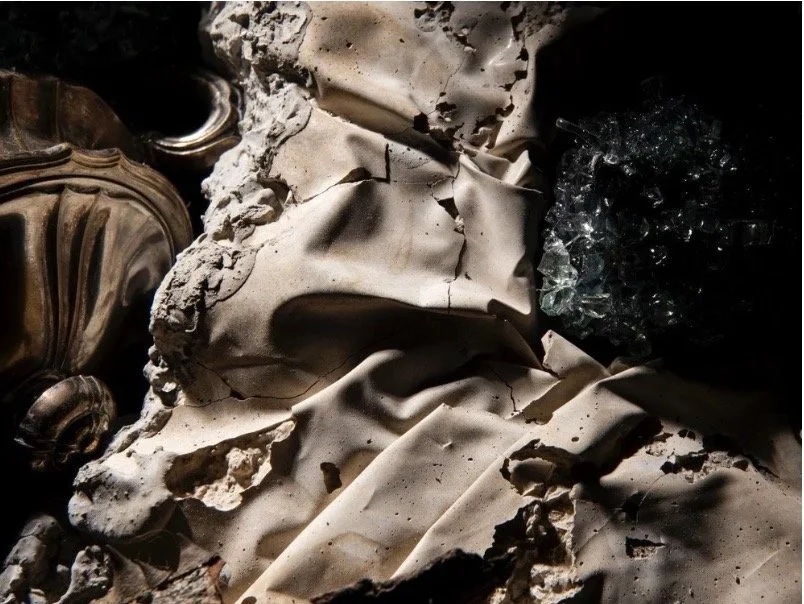
GEMA is Guadalupe Ayala's most ambitious and complex project to date, unprecedented in both scale and conception. Through its magnitude and boldness, it marks a decisive departure from everything the artist has created before.
Its power lies in its tensions: between monumentality and intimacy, stasis and movement, the visible and the concealed, the natural and the artificial, reality and fiction. The work demands that visitors move through it, transforming the act of viewing into a physical and symbolic experience. From below, the scale of the structure emphasizes the smallness of the human body; from above, reflections of glass and shifting light alter the rhythm of the surrounding space.
Conceived specifically for the National Museum of Visual Arts, GEMA embodies condensed time, where stability proves to be only an illusion. Ayala establishes a dialogue with key figures from the museum's collection—from José Cúneo to Águeda Dicancro—placing her work within a lineage of Uruguayan art that intertwines body, matter, and territory. The mineral body is never inert; it is matter in continuous transformation. In this way, the museum itself is revealed through its central paradox: the human attempt to contain the uncontainable, to preserve what is constantly changing.
Engaging with elemental forces, where earth, water, air, and fire converge through attraction and discord, Ayala transforms sculpture into the stage upon which these tensions unfold. GEMA offers a tangible reflection on the instability of form and the fragile equilibrium that sustains everything that exists.
FONDO
2025 – Spanish Cultural Center in Montevideo (CCE)
Curated by Fabiana Puentes
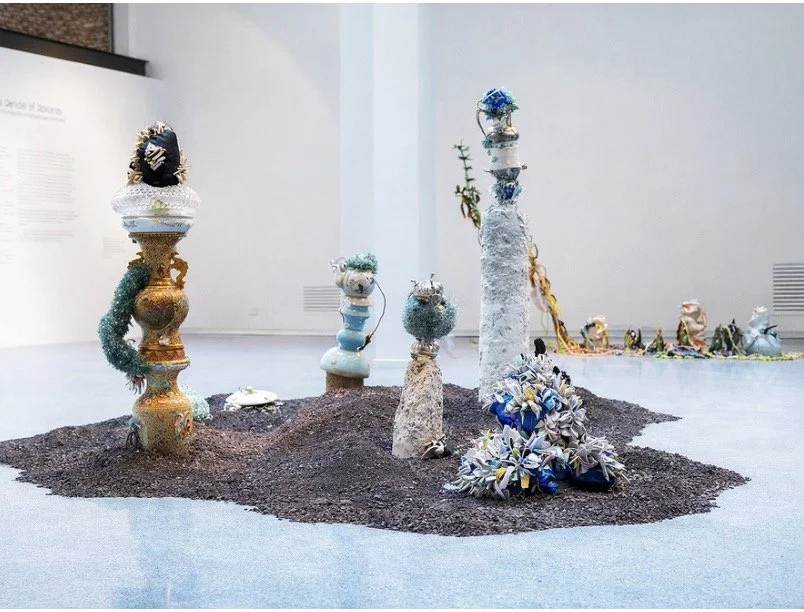
The work emerges from the debris of the present, reclaiming materials left behind by modernity. Through the act of bringing them together, function gives way to estrangement. Each fragment takes part in an action that approaches ritual—a careful dialogue with matter in which the artist places every element one by one.
From this patient practice emerges a displaced sense of time, detached from the acceleration of the surface, where lingering and persistence become acts of resistance against disposability. In this slower rhythm, listening to the materials grows more attentive. They begin to reveal their own modes of relation, establishing connections with their surroundings, responding, transforming, and enduring. Their composition carries the memory of what they once were: ceramic preserves the trace of fire, metal extends its alliance with the depths of the earth, and glass retains the mark of its fracture. Under certain conditions of light, that memory seems to awaken in flashes, as though matter itself were sending a message from within, much like deep-sea creatures communicate through bioluminescence.
The sculptures emerge as archaeologies of the future—organisms that, like deep-ocean ecosystems, thrive on the detritus descending from the surface, transforming waste into the very condition of possibility.
CONQUISTA III
2023 – Montevideo International Art Biennial
Curated by Rulfo Álvarez
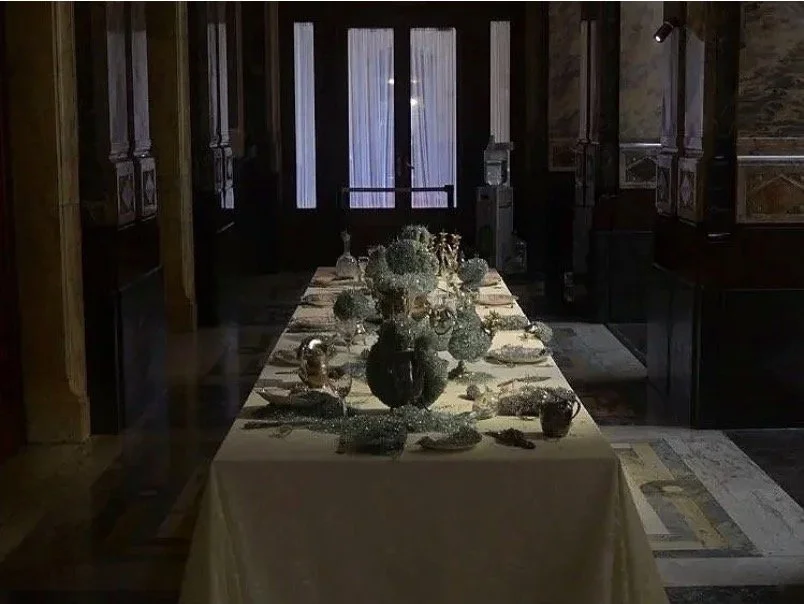
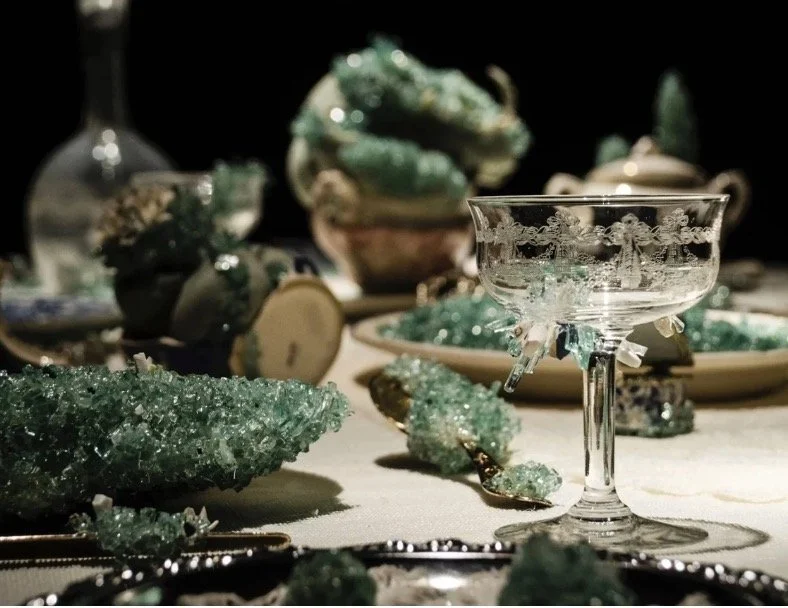
A table set for a special occasion still awaits guests who never arrived. Polished tableware, carefully prepared, reveals its own impermanence as crystalline blooms suddenly emerge and spread freely across its surface. A darkened environment frames a scene governed by ambiguity, dissolving the boundaries between the uncanny and the marvelous.
By poetically suspending both the practical and the social functions for which these objects were originally created, Ayala constructs a discourse on coloniality. If Jean Baudrillard distinguished between the different social functions of objects and exposed their political and ideological role in reproducing privilege, Ayala redirects their discursive potential by confronting their disparate origins. Through recontextualization, she resignifies these materials, generating a broader social and political reflection. It is precisely through the reinscription of their social functions that she offers a critical examination of the colonial power relations that continue to shape the present, revealing how culture is both configured and expressed through objects.
Rather than presenting a carefully arranged group of objects, the artist proposes an aesthetic and epistemological experience that unfolds into a far more complex historical and social narrative. Multiple temporalities coexist and enter into dialogue: the immediate present of the viewer's encounter with the work; a recent social past, reconstructed through the traces of violence embodied by shattered windows from stolen cars; a recent political past shaped by systemic economic violence that continues to limit participation and the equitable distribution of resources; and a deeper epistemic past—la longue durée, to borrow the term from the Annales School of historiography—that persistently sustains the paradigms through which the recent past and the present are configured, transforming colonialism into postcolonialism and capitalism into neoliberalism. These temporalities converge in a fusion of horizons, where tradition bears as much responsibility for the present as the present bears for the past it chooses to inherit.
Within a scene saturated with shimmering reflections and refined beauty, Ayala reveals how past, present, and future remain bound to the intertwined logics of permanence and transformation, to an ongoing process of appropriation, implosion, and emergence. On the surface, these crystalline formations evoke the seductive appearance of precious stones and the persistence of economic privilege. Beneath that surface, however, they become the mold of a culture slowly entering into decay. Growing like mycelial networks from antique silverware and English porcelain, they cast doubt upon the permanence of any social, cultural, or economic system. Through obsessive attention to detail and a profound ethical commitment, Ayala brings us face to face with a world shaped by dispossession and by a colonial tradition that has refused to learn from the most devastating failures of history.
GEMA within the Uruguayan Sculptural Tradition
2025–2026 – National Museum of Visual Arts (MNAV), Uruguay
By Laura Bardier, Curator
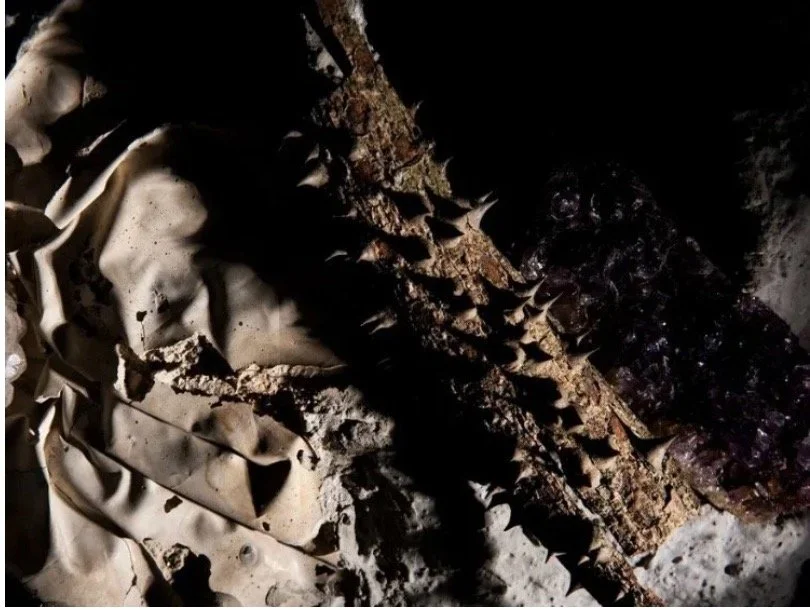
At the National Museum of Visual Arts, GEMA emerges as a living presence, a form that not only inhabits the space but activates it, questions it, and transforms it. Conceived by Guadalupe Ayala, the work does not impose itself upon the museum; it grows from it. Not as a metaphor or a decorative gesture, but as a radical act of listening and resonance with its architecture, its memory, and its collection.
GEMA revisits foundational questions explored by artists within the regional tradition: How can an artistic practice speak from and toward a regional identity without becoming literal or folkloric? How can art inhabit an institution without being neutralized by it? How can matter reveal the invisible? To these questions, Guadalupe Ayala adds others that are distinctly contemporary and universal, shaped by today's ecological, political, and aesthetic concerns: Are we witnessing an expression of nature or a construction of artifice? Is this an ancestral sanctuary or the remnant of what has been extracted and exploited?
Like Pedro Figari, Ayala places the body at the center of artistic experience. Whereas Figari approached it through representations of ritual and collective memory, Ayala proposes a direct encounter in which the visitor becomes part of the work itself. Both artists share an interest in mystery and the ancestral. Although working through very different visual languages, Ayala investigates symbolic and cultural structures from a contemporary perspective, one that is deeply concerned with power relations, the tension between the natural and the artificial, and space as an active device. Just as Figari quietly dismantled the official narratives of his own time, Ayala stages the defining tensions of ours: extraction, transformation, and the fragility of the environment.
Like José Cúneo, whose exploration of pictorial matter and landscape emphasized the expressive qualities of material, Ayala establishes an intimate relationship with the earth, with materials, and with organic forms. GEMA is not a direct representation of nature but a sensory invocation of its forms, processes, and tensions. Organic structures, folded surfaces, cavernous textures, and mineral reflections evoke the subterranean world, the geological origins of life, while simultaneously suggesting a living body in continuous transformation.
From a different perspective, Ayala's work resonates with Margaret Whyte's investigations into materiality, the body, and installation as symbolic and sensory fields. Whyte has developed a poetics grounded in softness, textiles, and suspended forms. Both artists employ industrial and everyday materials in ways that merge the handcrafted with the conceptual, allowing them to acquire emotional and ritual dimensions.
Through her sculptural approach—articulating materials, void, light, and time—Ayala constructs works that actively engage the viewer. As in certain works by Águeda Dicancro, the spectator enters, moves through, and inhabits the sculptural space; the work unfolds through experience itself. Both artists belong to a genealogy of women who have expanded the language of sculpture while challenging a tradition historically dominated by masculine monumentality. They conceive sculpture not as an autonomous object to be contemplated from a distance, but as an immersive environment that requires active participation. Dicancro's practice is distinguished by her use of glass, iron, and wood; Ayala shares this essential relationship with materiality, proposing works that are simultaneously visual and tactile experiences. Where Dicancro developed a poetics of mystery and transparency, Ayala brings that search into a contemporary context in which the invisible manifests itself through what remains hidden—whether ecological, historical, or institutional.
By conceiving GEMA as a work that cannot exist outside the National Museum of Visual Arts, Ayala also establishes a relationship of complete integration between artwork and space, between artistic gesture and institutional architecture. Joaquín Torres García spoke of a "deep structure" of art connected to the order of the universe. Ayala reinterprets that notion, proposing a sculpture that does not represent the spiritual but embodies it through lived experience: a living structure that breathes alongside both the viewer and the building itself.
In silent dialogue with the museum's collection, GEMA reconfigures our relationship with tradition. If the collection invites us to understand the history of Uruguayan art through its foundational images, Ayala invites us to approach it through its fissures, through what remains unseen. She intervenes in the space as though it were a sensitive membrane, recognizing both its capacities and its limits. As throughout her practice, the physical is also symbolic. GEMA speaks of what is hidden, of what emerges, of what resists being articulated. It is a work that demands time, movement, and active perception. Rather than organizing space as a container for artworks, it transforms the museum itself into an experience.
Ayala responds with a contemporary, radical, and distinctly feminine voice that expands the horizons of what art can be today. The National Museum of Visual Arts preserves a rich visual history of landscapes, portraits, and the founding gestures of Uruguayan modernism. Within that context, Ayala's practice introduces a productive tension. GEMA is not a work made for the museum; it is a work made with the museum. In that distinction lies its power. GEMA does not decorate—it unsettles. It does not illustrate—it summons. It is a contemporary gesture of critical engagement with the institution, insisting that art can still serve as a way of knowing—and transforming—the world we inhabit.
INVASION
2018 – Gurvich Museum
By Hugo Achugar, Curator
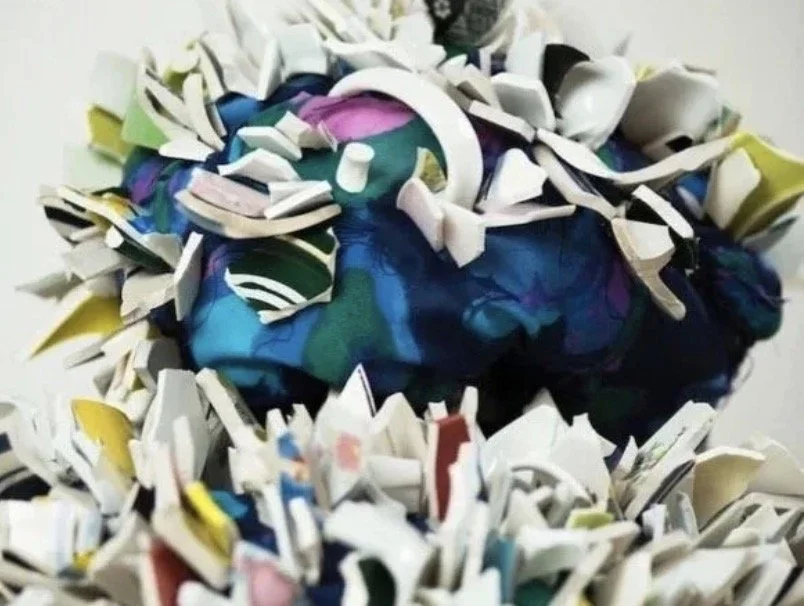
"Traduttore, traditore" ("translator, traitor") is the old Italian saying that Ayala playfully transforms into tradition/ betrayal. The relationship is clear, and Ayala establishes a continuous dialogue between herself and Gurvich. The installation—titled Invasión (Invasion)—appears to surround Gurvich's work, yet it does not. Each remains in its own place, and yet not entirely. The installation advances until it incorporates the two-dimensional image of Astral Couple (Pareja astral, 1968–1969). Rather than proposing a translation, it becomes an act of assimilation and exchange. Through fabrics and porcelain, Ayala constructs metaphors of the domestic sphere, of inheritance, of what was once whole and has now become fragmented into multiple broken references.
Ayala herself reflects on this process in a text written during the development of the work. There she describes her dialogue with Gurvich, her impulses, and what she calls her "premises": "One premise: to migrate from Gurvich's work into my own." Thus, Astral Couple is reconstructed through the dialogue established between Ayala's diptych and Gurvich's painting. Each artist remains distinct while inhabiting the same symbolic space.
Every migration carries both material and emotional dimensions. In Gurvich's case, one cannot overlook his Jewish heritage, his relationship with the Cerro neighborhood of Montevideo, his experience with Joaquín Torres García, and the legacy of the Western painting tradition. Ayala, for her part, "crosses the river," migrating herself, carrying with her "only a few plates and some bed sheets (nothing more—and nothing less), which became my family inheritance from that home where happiness once flourished." In both cases, crossing borders implies transformation and the capacity to embrace the unfamiliar. Beyond earthly or astral journeys, beyond beloved places, what ultimately remains is family inheritance understood as an emotional legacy.
Plates, porcelain, earthenware, sheets, batting, and fabrics are what Ayala brings with her. But she also brings "the audacity to imagine the unknown." She gives color, form, and structure to her encounter with Gurvich's painting and to the memories, associations, and emotions it awakens. Gaston Bachelard anticipated this when, in The Poetics of Space, he argued that imagination unfolds through journeys and displacement, mapping intimate territories where the small, the hidden, and secluded corners become inseparable from lived experience and feeling.
In Invasión, Ayala undertakes a journey into her personal past, for every act of creation is ultimately a journey. Displacement becomes an exercise in artistic creation. Imagination itself is a form of displacement. Imagination as an exercise in chosen memory. Imagination as a way of entering into dialogue with multiple inheritances. Imagination as a way of welcoming the new. Imagination as a dialogue between spaces and meanings.
CONTIENDA 2DO. ROUND 2015 – Espacio de Arte Contemporáneo (EAC), Montevideo
By Santiago Tavella, Curator
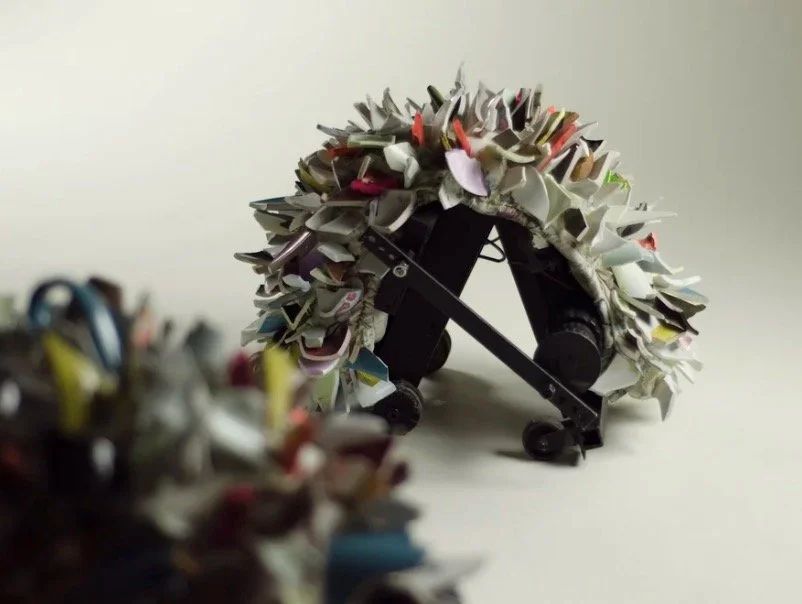
The contenders created by Guadalupe Ayala possess several qualities that make this fictional scenario resonate with contemporary life. To begin with, their construction displays remarkable aesthetic qualities. There is a particular beauty in them, perhaps rooted in Ayala's mastery of materials and, above all, of color and the relationships between colors. They inevitably recall Miguel Ángel Pareja's description of painting as "the drama of life painted with colors." While Ayala's work is not painting, the concept seems entirely applicable.
These robots, programmed for mutual destruction, embody two dominant attitudes of the contemporary world. On one hand, they evoke the religious fundamentalism of those who "know" that sacrificing themselves for a cause will be rewarded in paradise. On the other, they suggest the cynical disbelief of unrestrained capitalism and its principal mechanism: consumerism. In both cases, one need only have read a basic psychology manual to recognize what psychoanalysis describes as the death drive—or jouissance, in Lacanian terms.
Clearly, there would be little point in advising these creatures not to stop and read Gianni Vattimo's writings on weak thought, or to follow former Uruguayan president José Mujica's recommendation to avoid getting caught in the "Viru Viru" of the humanities and instead make something with one's hands (although Guadalupe's creatures, of course, have no hands). Nor would it help to encourage them to follow Japan's example, where some universities drastically reduced or eliminated humanities and social science programs in response to government policies favoring disciplines considered more directly useful to society.
Yet observing this confrontation may lead us to question the extent to which we ourselves behave as programmed beings. It invites us to wonder whether, in one way or another, we are all programmed, and ultimately to ask what it is we truly want to do. Something akin to Slavoj Žižek's proposition: "Don't act. Just think."
If we place ourselves in the position of these contenders, we may conclude—borrowing the words of The Beatles' Nowhere Man—that they "don't have a point of view, know not where they're going to." And perhaps they are, indeed, "a bit like you and me."
Unlike them, however, we retain the possibility of choosing what we truly want to do. It sounds simple, yet for most of us it is a task that lasts an entire lifetime.
SAQUEO
2022 – Gladys Afamado National Prize for Visual Arts
Grand Acquisition Prize
By Guadalupe Ayala
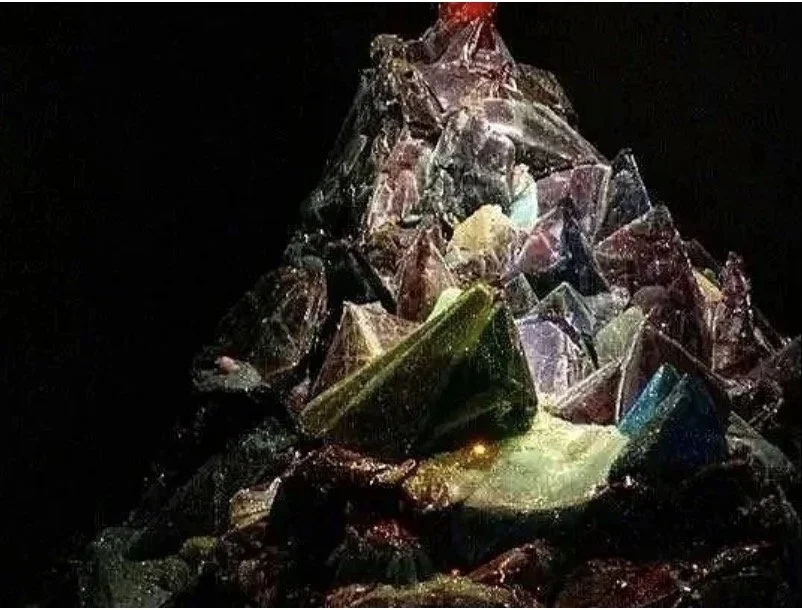
The Ransom Room is an Inca structure located in the city of Cajamarca, Peru. It was here that the Sapa Inca Atahualpa, the last sovereign of the largest empire in pre-Columbian America, was held captive for nearly nine months.
Atahualpa's story is marked by one of the most devastating betrayals in the encounter between the Indigenous peoples of the Americas and the European conquerors, as well as by one of the greatest acts of plunder during the processes of invasion, domination, and expansion carried out by the Old World.
In 1532, the Spanish began the conquest of the Inca Empire. That same year, Francisco Pizarro summoned Atahualpa to the main square of Cajamarca, where he and his men ambushed him. Thousands were killed, and Atahualpa was taken prisoner. In exchange for his freedom, he offered to fill his prison cell with gold and silver objects: jewelry, vessels, jars, and ingots. The ransom weighed more than 200 tons, exceeding Europe's total gold production over the previous fifty years.
Despite fulfilling his promise, Atahualpa was baptized under the name Francisco and sentenced to death on charges of idolatry, fratricide, polygamy, incest, and concealing treasure. He was executed by garrote on 26 July 1533.
It is considered the largest ransom ever paid in human history.
All materials presented in the exhibition belong to the artist's personal collection and constitute the entirety of the raw material she uses in the production of her work.
CONQUISTA 2017 – Montevideo Visual Arts Award
By Guadalupe Ayala
The history of humanity is, among many other things, a history of migrations. It begins when human beings stood upright and started moving across territories, colonizing their surroundings. Since then, countless processes have unfolded: invasions, subjugation, domination, revolutions, and forms of coexistence.
The Spanish—and Portuguese—exploration and colonization of Latin America became one of Europe's greatest appropriations, both in the scale of the territories it occupied and exploited and in the profound economic, political, and social consequences that reshaped the world as it was then known.
Uruguay, however, did not fully reproduce several defining features of the colonial occupation of the Americas: the establishment of a European-style bourgeoisie, the constitutional adoption of Christianity as the state religion, or the celebration of opulence, among many others.
Yet, despite every conquest, the land is never an empty vessel waiting to be filled. It existed before others arrived, and it becomes something else once they do. It is continuously reconfigured. The Uruguayan patriciate, the particular ways in which the Laws of the Indies were applied in Montevideo, the so-called "barbarian" sensibilities and their disciplining, the forms taken by military conflicts, militias, and political allegiances, as well as the contested absence of a self-sufficient agrarian economy, all departed from the original colonial design.
These parasitized table settings, these hosts, their symbioses and mutualisms, their forms of biological coexistence, these diners, this table, and its ruins reflect the contingency of conquest and the silent passage of suspended time. Just as human beings transform one another, so too does nature transform humanity.
Catalogues
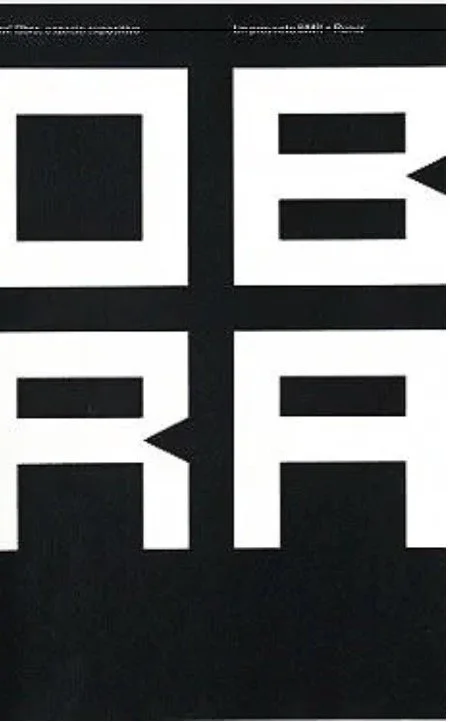
OBRA 2024
Institution
BMR Productora
Texts
William Rey Ashfield
Sofía Rossi
Gonzalo Linares
Year
2024
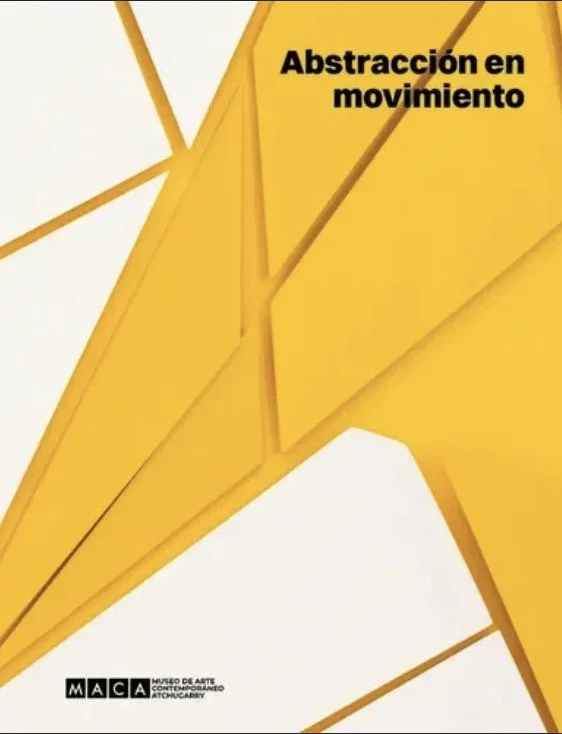
Abstracción en Movimiento
Museoum
Museo de Arte Contemporáneo Atchugarry (MACA)
Curator
Martín Craciun
Year
2023
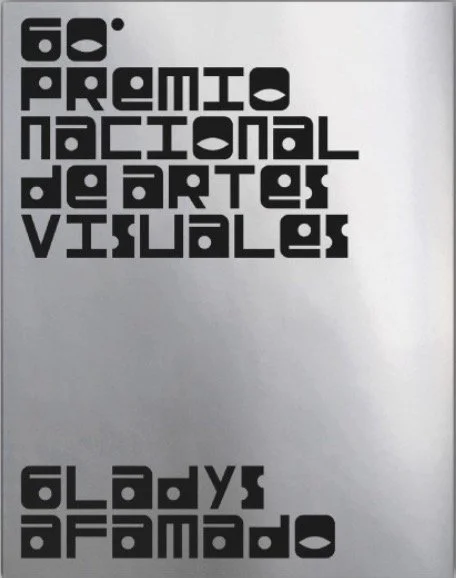
60th Gladys Afamado National Visual Arts Award
Institution
Contemporary Art Space (EAC), Montevideo, Uruguay
Jury: Amanda de la Garza, Patricia Betancour, Ricardo Pascale
Year
2022
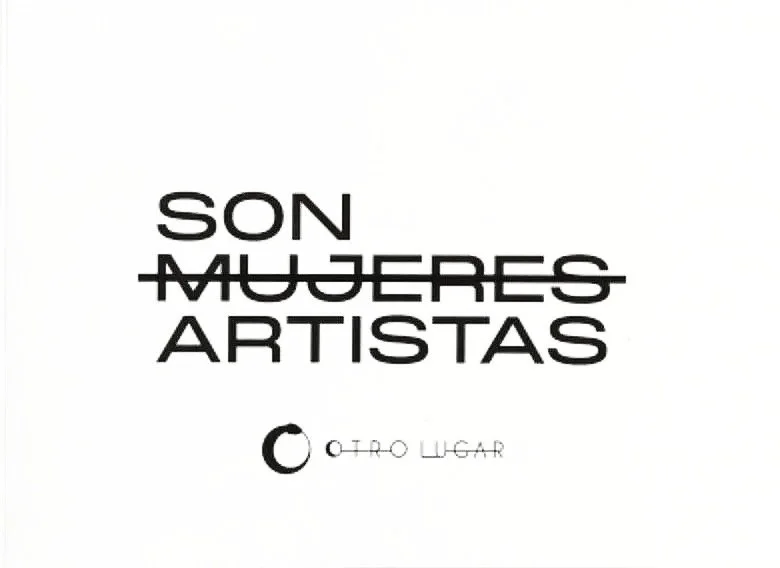
Women Artists
Gallery
Otro Lugar Gallery
Curator
Mamu Camacho
Year
2022
59th Margaret White National Visual Arts Award
Institution
Contemporary Art Space (EAC)
Jury
Florencia Flanagan, Elisa Pérez Buchelli and Martín Craciun
Year
2021
Por una Cabeza
Museum
Zorrilla Museum
Curators
Nora Kimelman and Adriana Rostovsky
Year
2021
Imagination: Dialogues and Challenges. Gurvich and Five Contemporary Artists
Museum
Gurvich Museum
Curator
Hugo Achugar
Year
2018
48th Montevideo Visual Arts Award
Institution
SUBTE Exhibition Space
Jury
Cristina Bausero, Raúl Rulfo Álvarez, Ernesto Muñoz, Analía Sandleris and Marcelo Legrand
Year
2017